Slow down. Take the train.
Pamela Mulloy on what's happening in fiction - and on railway tracks

I
It only makes sense to take the train to meet Pamela Mulloy in her hometown to have a good natter about trains, so that is how I travelled to Kitchener-Waterloo last Wednesday. Tapped myself into a direct GO from Union to Kitchener at 12.34 and a couple of hours later, we were sitting in one of the charmingest KiWa cafes which happens to be right next to the train station, drinking cold brew.
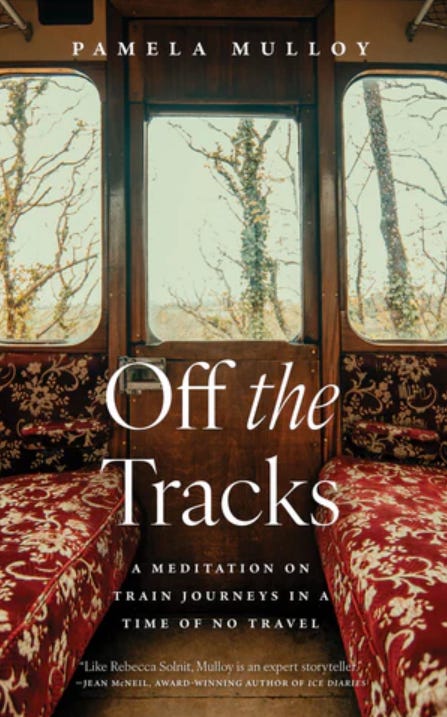
Author and editor of the literary journal The New Quarterly (TNQ) lives in KiWa with her Laurier academic husband and adult daughter. Her most recent book, Off the Tracks: A Meditation on Train Journeys in a Time of No Travel (ECW Press, 2024) was a project she embarked on as the pandemic shut the world down and cancelled all her trips lined up for the year.
“I’ve always wanted to write a book about trains, fiction or nonfiction,” she tells me. The pandemic finally forced her hand: if she couldn’t travel, she could at least sort out her slow travel memories and immerse herself in the history, politics and esthetics of taking the train.
Starting with the annual trip that she would take to visit family in New Brunswick with her daughter since the kid was 5: Kitchener to Moncton via Toronto and Montreal, by train only. The book opens with a detailed description of that beloved itinerary and ends with it too just as the post-pandemic travel is slowly, chaotically coming back, and the pair are back on The Ocean.
In between we learn about the most important trips taken - aside Canada, Mulloy lived in Poland, England, and the US, and life sent her crisscrossing each country by train.
It wasn’t so much about individual trips, she tells me. “I was interested in writing about being on a train. The feeling you get, the safety and the forward motion at the same time.” And “I allowed myself to roam in many directions in this book, wherever research took me.” Immediately she noticed that there aren’t a lot of written records by women travelling on their own by train. Indexes in history books, if you look up women and trains, she says, would usually come accompanied by the terms like ‘danger’ and ‘chaperone’, but then she came across ‘crinoline’ as a sub-topic, which led her to write the section on women having to manage complicated frocks in transit. We learn about the Pullman cars, and the Black Brotherhood of the Sleeping Car Porters, and ‘Le Sarah Bernhardt’, the famous actress’ personal train that she travelled on while on tour through Canada and the US.
Mulloy is a rare North American in love with train travel when there are so few of us left. “Well, train was essential travel when I was a student, away in Nova Scotia,” she says. “None of my university friends had a car back then, so we thought nothing of taking the six hour train ride back home”. In Europe, she travelled by Interrail pass - it was what young people did as a matter of course.
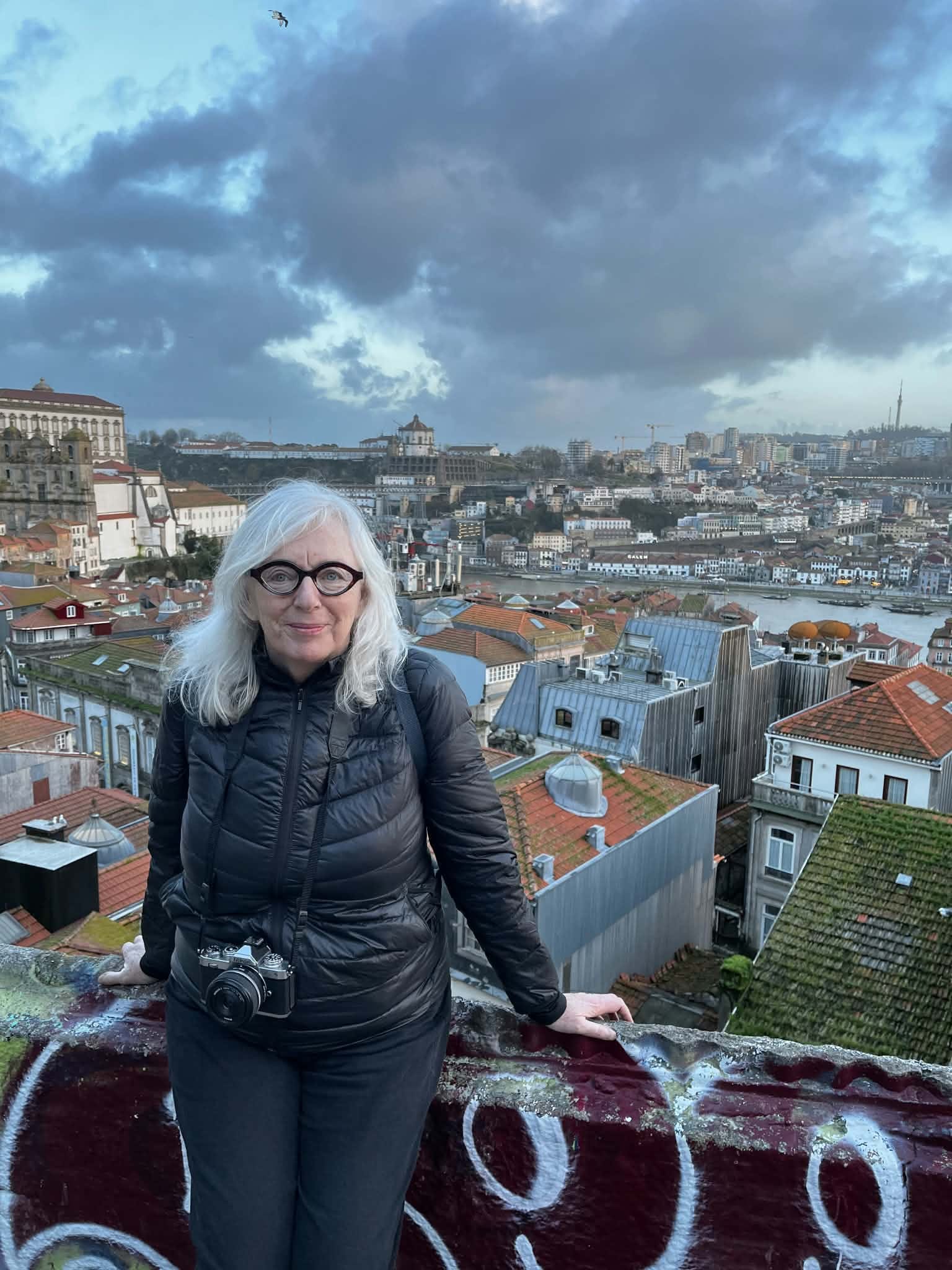
You don’t see the train as a waste of time? “No, I see it as a time given back to me. I can work on a project. I am using the time just for myself. And I feel I’m moving while also doing something else. It’s the most comfortable method of getting anywhere.”
It wasn’t always like that. When rail travel was introduced to industrial societies, it was seen as a major disruption and a despoiler of the bucolic countryside. There’s a great line that Julian Barnes gives to Flaubert in Flaubert’s Parrot, giving voice to his tech progress skepticism: the train will only allow more people to “move about, meet and be stupid together”. Some of the most interesting passages in Mulloy’s book are about the shock and the unprecedented speed and noise of train travel. People spoke of the PTSD-like effects, and “the madman on the train” phenomenon was quickly identified: a seemingly normal individual going insane by the stress of being on a train. (Today we speak of road rage and ‘unruly passengers on flights’, as these two travel methods remain reliably stress producing.)
“Now train rides are seen as slow and gentle,” Mulloy says, “but early on the train was a shock. One of my husband’s colleagues who writes about the Victorian age dedicated an entire chapter in one of her books to the madman on the train. It was a thing.” There’s a lot of Ruskin in this section, as is to be expected. “He hated the whole enterprise, thought the train just ships us like parcels, mindlessly, about.”
The third class cars in early trains were indescribably bad - and built without a roof. And the trains taking recently arrived immigrants from Halifax across the country renamed the cheapest ticket category ‘the colonist class’.
Rail travel however transformed to become the most romanticized travel method of all.
I ask Mulloy about her favourite cinematic representations. Brief Encounter is the book, as is the early Lumiere brothers’ The Arrival of a Train at La Ciotat which allegedly had people running from their seats in the late 1800s. But she chooses the 1955 Summertime, directed by David Lean, with Katharine Hepburn as a secretary from Akron, Ohio who saved up enough money to travel to Venice, fulfilling a lifelong dream. “It’s the woman travelling alone storyline. Things happening to her, and the transformation that follows.”
II
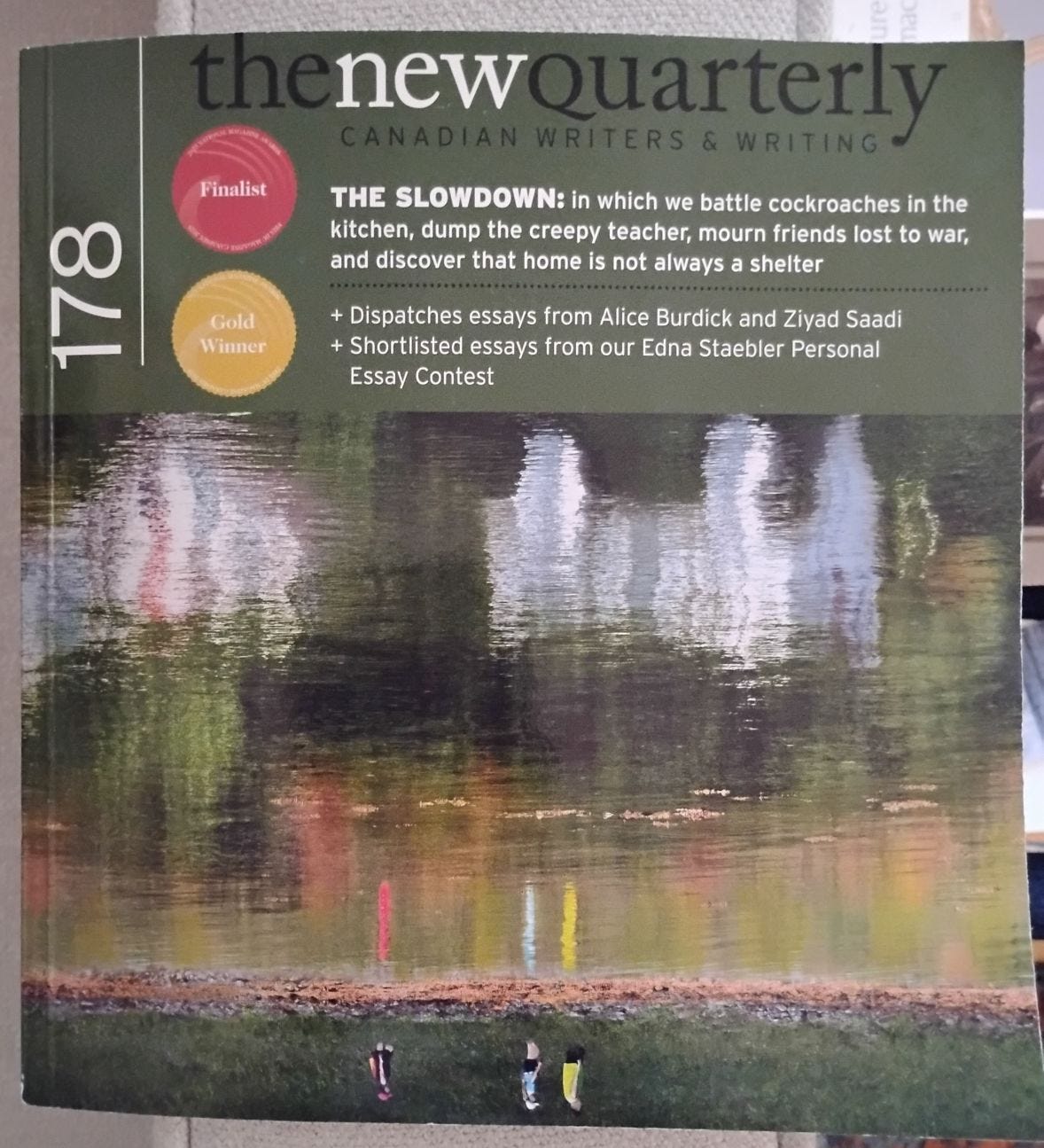
The New Quarterly just celebrated its 45th anniversary.
How did they avoid the politicization of the 2020s, I was curious to know. Some magazines and artist collectives cancelled themselves in acrimony; other organizations made themselves paralyzed for years. (Buddies in Bad Times, hello.) Fiction, especially in Canada, adopted social justice priorities.
“We want to stay relevant,” says Mulloy. “We want to be publishing what’s interesting for people to read. But the craft of writing is also really important. I’m not looking for topics so much as I’m looking to read something that is original and well written. Sometimes that will be political and involved in social justice, sure, but I’m not necessarily searching for it. I am looking for the craft. We can’t chase trends, I’m not interested in that.”
“When people were making political statements about Palestine,” she continues, “we decided to let writers speak, individually, and we started the series Dispatches. We invited people from a range of voices to submit. Rather than us making a big statement, we thought, let’s ask writers to tell us how they see it and how they see the job of writing in these times.”
Has she noticed fiction changing in the last couple of decades, I wondered. Some readers point out the dominance of the MFA creative writing programs and argue that it standardizes fiction to fit acquisition preferences by the major publishing houses. Then there’s the dominance of realism and psychological novels in English language publishing. Finally, writing across ethnic lines has been problematized - and to some degree across gender, and sexual orientation lines.
“What I’m noticing is - and I’m not sure if this is the effect of the MFAs - that story has become prominent, at the expense of everything else. Story as opposed to the craft of writing. Now why is that. And you see that in books, especially. It’s probably much easier to market; ‘what’s the story here’ is how you sell something. As a literary magazine we are not driven by market forces the way publishing is but you notice it.”
Also on the rise: the memoir, which is overtaking other non-fiction forms.
Perhaps this too is the expression of ‘you write your own ethnicity only’, I suggest. You write what you know.
“I think that people should be able to write across ethnic differences. It’s not always about writing what you know - or your project will become narrow. I think you can write different characters with care and respect and present it all in a way that shows that you are invested in the subject. You hope to do that with any of your characters. We get stories with a female perspective by male writers, for example, and people do a good job. You see that they’ve done the work.”
I wonder about the words respect and sensitivity… most of us, being flawed individuals, can’t and shouldn’t command narrative respect and deference, the flaws should be shown, but I know what she means. It’s reality v. fantasy.
“Yes, I mean avoiding the fallback on cliche or stock characters, not taking a well-trodden path. Treat all your characters as complex individuals they are. This is harder to do.”
I ask her if she’s been following the AI-submission scandals and if TNQ has a protocol in place. “We’re just talking about getting an AI policy. We have several readers and we know some of the basic things to look for, but it is a concern.”
And a good occasion to talk to younger writers about why they write, she adds. “What is the reason? Do you write to be published, primarily? In that middle between you having an idea and getting published is where all the interesting things happen. That is the work. And it can be exciting, figuring out what it is you want to say. You can’t contract out that part.”
Mulloy often reads submissions that make it obvious that the writer didn’t give it enough time to shape the piece. “We don’t have a word limit and we sometimes get 3000-4000-word submissions and many would be improved by being shorter. I often tell writers, whenever you think you’re done, try reducing your piece by twenty percent and see what happens. The writing will improve from this exercise - just because they have to look at it at the line-by-line level.”
Other literatures produce slimmer novels, I thought. You look at the French novel, Italian novel, they tend to be thinner. Anglo countries still produce massive novels. And I think this is because the other guys wrestle with every sentence and prune and chisel. Maybe we write big, story-driven novels because of the influence of television?
“It’s possible. Also, story requires less attention. How much patience do today’s readers have for wading through some of the language that doesn’t necessarily go anywhere? Character driven novels where not much happens, I can stay there a long time, but it’s not what people are used to now.”
Pamela Mulloy as a reader
Helen Humphreys. We are friends now, but I was a fan first and friend later. When I first moved to Kitchener after living in Europe for many years, I knew nothing about CanLit. There was an event in downtown Kitchener with Helen, and when I heard her talking about her book and when I first read her, I thought, OK - I can live here. I found a connection.
Deborah Levy - the Trilogy! What an accomplishment. And to do it three times in a row.
Tessa Hadley
Natalia Ginzburg
Claire Keegan
(all slim books! NB)
Kiran Desai. I remember being amazed by the prose in The Inheritance of Loss, I should re-read it.
Katie Kitamura - Intimacies in particular
Kagiso Lesego Molope, We Inherit the Fire.
On whether people will ever like Alice Munro’s fiction again
At one point in our roaming conversation I tell Mulloy I’m probably one of the few who doesn’t really care that Munro wasn’t a good mother, and was possibly a terrible person by inertia and a certain ethical laziness. It changes nothing for me, except that it makes her fiction darker perhaps, now that a lot of it is being read back as coming from Munro’s own life. Mulloy: “It will be interesting to see how we read her in 10 years. Now we are too close to the event, and it will take time for us to see if we can reassess and go back to the actual books.”
I agree with what you say about Alice Munro. Whatever her shortcomings as a person, and the reason for them, she was a brilliant writer whose stories will resonate through the years.