Sorry, no thank you, please
Les mots and les choses, once more

I miss Deborah Cameron.
The social linguist out of Oxford U who published an impressive number of influential general-readership books and maintained a popular blog about language usage, died in November. We were Twitter and Facebook mutuals and I’ve used her crusty no-knead bread recipe for years. She would often intervene in a cool, analytic manner in some of the hottest debates happening in the media trad and new, and when I stumbled across the latest X spat involving language, I rolled my eyes and thought how I’d very much like to check what Deb thought about all this, certain she’d be cool-headed as usual. Alas.
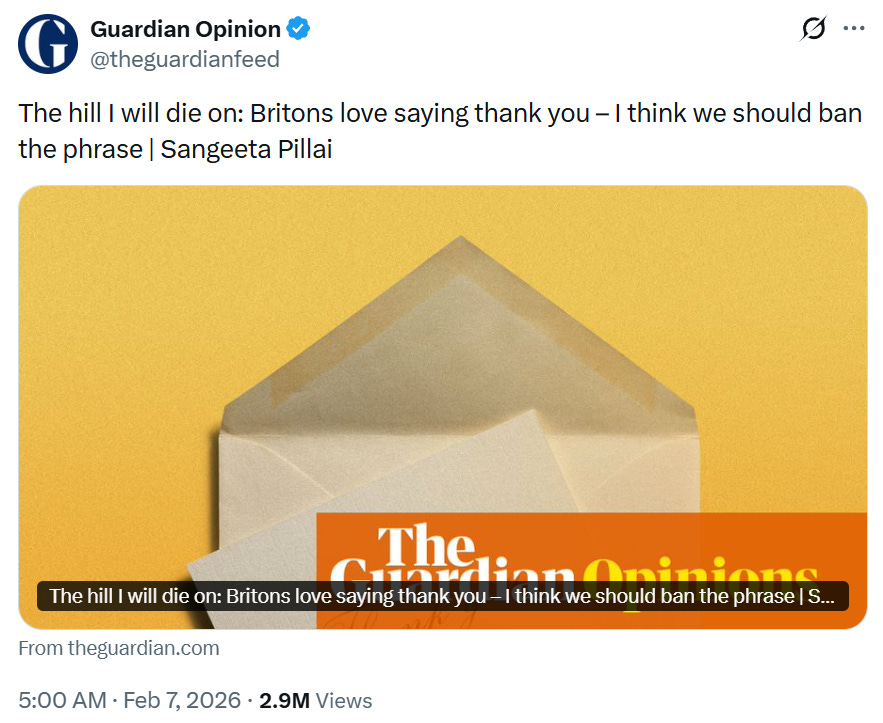
Because X is so easy to troll these days and hysteria flares up in predictable X circles in a predictable manner, a whole lot of followers of mutuals have been raging about this Guardian opinion piece which was published in the intentionally rage-baity (hey, have you heard what happened to journalism’s business model) Hill I’ll Die On series. Britons, says the India-born now-British writer Sangeeta Pillai, use thank-you so much in everyday interactions that the phrase stopped signalling gratefulness and now functions as a filler in all kinds of unrelated contexts. Well, the piece isn’t exactly superbly written, but I got her gist. There’s also been an inflation of ‘sorry’, something which will be obvious to Canadians who, much like the Brits, say sorry to the person who bumps into them.
How about you go back to India if you want the British to stop being British, was the essence of the many hundreds of less politely phrased tweets against the author. The formerly reasonable seeming people have been posting about this op-ed for days, coming back to express how irritated they are. Do you want to abolish the queuing too, the essence of our nation? No, her point was that she too says thank-you too much, being British now, did you read the piece? Damned foreigners, damn open borders, down with this Labour government, etc. all the way to a civil war is near, close the hostels with migrants and so on.
Look, I understand the pleasure of a self-righteous post as much as the next guy. But if anything’s going to finally get me off X will be the realization that the right-wing X is even more obnoxious than the progressive Twitter was.
There is a bigger topic here: the degree of formality in various cultures and the status of certain important words in them. I also - like Sangeeta, who should have elaborated better - come from a culture where formal address is reserved for formal situations and for strangers. You would never say thank-you to close family members in the course of the usual intra-muros family life and introducing thank-you or good-day and good-night to close friendship or partnership would mean introducing a certain degree of distance between the people involved. If you are close to your siblings, you never say thank-you. Doing things for each other is par for the course. You show you’re grateful by reciprocating.
A close family member who lives in Britain married a man from a Central European culture and those few times that she had some of us old riffraff over in her house, it was noticeable that she had upped her expectations of formal address to match his. She would get upset if I didn’t say thank-you every time he passed me a salt shaker, or that I wouldn’t say a chirp Good night! before going to sleep in the guest room. My ‘OK I’m turning in, see you tomorrow’ suddenly became unacceptable. Her expectations of formal address became as vast as his family’s apartment in central Budapest.
There’s a bit in a Dasa Drndic book where the narrator, on a writer’s retreat somewhere in a wealthier and more western country, comments on the fakery of the thank-yous and pleases expected of them in some context or other.
More controversially, no one ever in a million years in my corner of the Western Balkans says I love you to a close family member that they love. It’s also fairly rare with life-long partners. Just as you don’t do flattery; there is something suspect about feeding someone pleasant words. Putting a sensitive feeling like love, admiration, loyalty, and even workaday gratitude, into shiny words and frequently - moving the sacred thing into the phonemes, which are always in a marketplace, always an exchange - means devaluing it. What is it that you want in turn for those words, is the suspicion. You show that you love someone by your actions. You vote, as it were, with your feet - and arms, and head, and your entire self.
I was surprised when I realized that there are people among us here in middle class Canada who say I love you to their adult child every time before they hang up the phone. Isn’t this an inflation? (And we know what inflation does to the individual item in the series being inflated.) Another affirmation in a society that is bent on over-affirming? I am certain most people show that they love their children by everything they do every day. Or am I just too marked by a taciturn, deed-oriented culture distrustful of loyalty-expressing words?
I am sure that this is now changing, in my old and a lot of other cultures, under the aegis of the internet-globish culture. And adults do need to hear those words spoken sometimes. Do we need them every day, and why would we need them every day? Thank you thank you thank you thank you love you love you love you love you, lest we feel undervalued.
One of the reasons that so many of my good friends are in their sixties, seventies and eighties is that we grew up and were educated at the same time in the same way. Canadian society has changed in the last 50 years the way other societies - and education systems - are changing now. Not all of it is good, as I’m sure you’ve been noticing.
I know you’d have a lot to say on this, Debbie. You are greatly missed.
Speaking of Montenegro… I was a guest on the podcast Zinzula for an hour-long interview discussing anything from noisy neighbours in my apartment building to what is Canada to do now with Trump next door. If you speak any of the South Slav languages, here it is. If not, you may understand the words like kanadski nacionalista and Карни and Трамп only.
Recommendations
A Cubist play about two sisters
A French film which is about one thing officially, but about something else if you know how to look
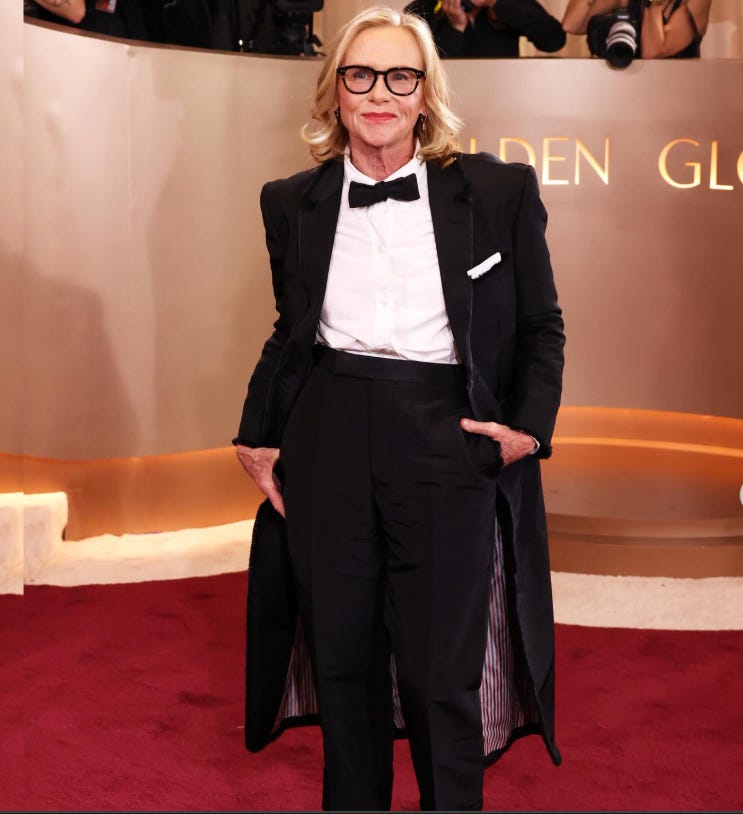
Can you keep your actual face and still have a Hollywood career past the age of 40? A recent case in point
Best use of poetry in film
Lets go: