What we learned this week about promoting a memoir in the attention economy

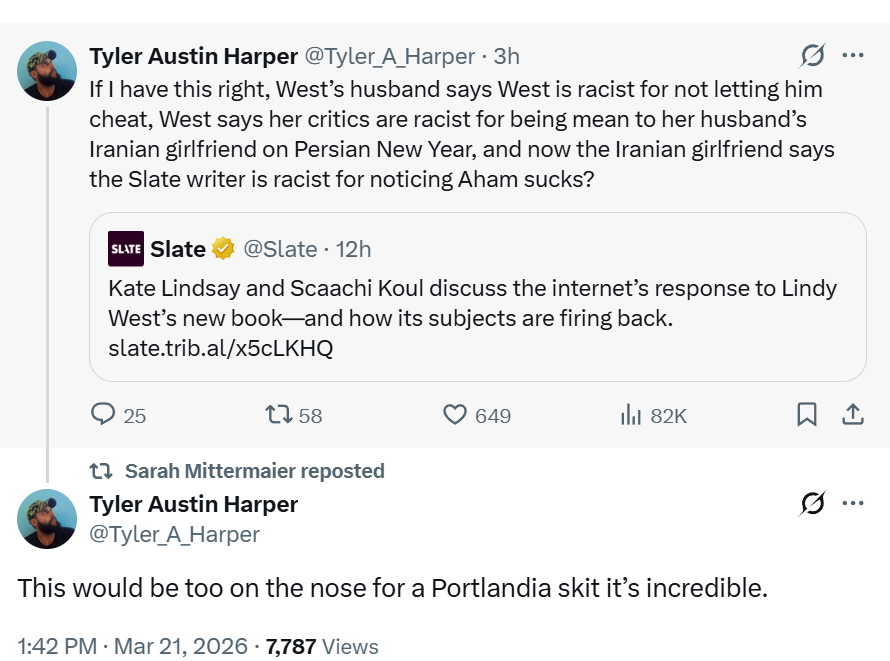
After weeks (months?) of op-eds, in-depth features, podcasts and Substacks about Lindy West’s memoir Adult Braces, in which she writes about her husband opening up their marriage so he can date other women and her initial struggle with the idea before the full embrace of (his) polyamory, and the magic transformation of it into a joint progressive political project, I’ve learned something about promoting a non-fiction book in an oversaturated market.
You need to write a book with a toupee and pretend you’re the only one not seeing it.
Given the blazing fire of media coverage that her memoir which sounds not at all fascinating has been getting, I am at this point near certain that Lindy West knows what she’s doing. Most of the coverage has been trying to educate LW about her naivete, explain the politics of her decisions to her, show her the comedy of her ways. At a rate of ten pieces or podcasts per day. We are so embarrassed for her. Ka-ching. Is she even aware that she has become a sister-wife of the kind only seen in certain religious minorities. Ka-ching. Lindy West: a trad wife for the progressives. Ka-ching. And her husband’s girlfriend is so thin, what does her fat activist self have to say about that. Ka-ching. Here’s a podcast episode on how LW and her hubster are now accusing everyone criticizing them of racism. Ka-ching. Her book is breaking through like few other non-fiction books this year.
I could easily picture a conversation with a publicist, and they happen now even before the books get written. “How about I write this as this good-natured innocent who’s the only one not grasping the Big Issue here? Why don’t I write this as me at my feeblest? That’ll open up a flood of correction. It will produce so much copy! I can hear the podcasts already.”
A similar thing happened with Elizabeth Gilbert’s memoir a few months ago. “How could this narcissistic monster not realize” etc. She did. Whether the desire to murder her dying partner did actually appear in her head and how seriously she entertained it, no one can know. Gilbert the narrator made it into a thing. It turned the book into conversation fuel, which a grief memoir without it wouldn’t have achieved.
This is how marketing shapes the very writing of the book - in advance. The book needs to look like it’s under-noticing A Thing We Need to Tell Its Author and the World About. It needs to leave room for the commentators to make it - to complete it - as a culture phenomenon.
Same goes for longform memoir pieces in magazines. Some of you will remember the Emily Gould piece in the NYMag about how she almost wrecked her marriage - significantly, with another writer who knows the rules of the game of memoir writing and kept shtum. The reactions raged online for what felt like weeks. Again, we have no idea what if any of it was true. It’s a piece of writing that was custom-made to go viral - that is, custom-made to provoke the commentariat which is always in need of copy. That it accomplished.
It will be the same with the Lena Dunham memoir expected this year. What will be her new revelation, faux-naively presented? We can take bets. She’s probably on ozempic by now so the change of mind on the so-called body positivity can’t be it.


And in a couple of years Lindy West will have a book about the breakdown of her marriage. How I Realized What Was Going On. It won’t receive a fraction of the coverage of the current book. You have to write books which will feed the Discourse. Oversharing, narcissism, all good ingredients, but won’t go very far without a visible lack of self-awareness (performed or actual). Reason why books like Meghan Daum’s The Catastrophe Hour won’t become bestsellers is, inter alia, that she is a very self-aware writer, capable of turning critical thinking on herself. We seem to want our memoirist to be slightly dim about their situation.
Another factor that will increase sales: fabricating stuff. Amy Griffin’s ‘memoir’ which tells of her therapy-uncovered memories of rape got her on Oprah, the Drew Barrymore show and the Reese bookclub and sold gajillion before anyone in the media outside podcasts like Maureen Callahan’s The Nerve started asking questions about the alleged rape. Now the book will continue to sell on the wave of trial-related media as Griffin is being sued. The Salt Path, which we now know is mostly self-congratulatory fiction, continued to sell well precisely due to the scandal around its credibility. I’m sure we’ll see more books from Raynor Winn aka Sally Walker with Penguin, her original publisher. Selling a memoir does not depend on its trustworthiness.
Writing as personal branding
While we’re on the topic of non-fiction publishing, Rachel Hewitt had a good piece recently about her experience trying to sell her fourth book. Interesting topic, but you have no platform, and we can’t just create the book’s readership ex-nihilo was the reason she was given for the rejections. One of the important items in the job description of a publisher - creating readership for a book that does a new thing, says something previously unarticulated - is no more. Authors are expected to emerge fully platform’d. I wonder if she queried the Big Five only.
I’ve seen publishing influencers and consultants, notably Leigh Stein, argue this for some time now: that authors will have to engage with potential readers and create their own audience in a very direct way by building their ‘online capital’ and then proceeding to write for the group of people that they interact with. But the skill of being good on TikTok and in photographs, the whole business of being a good manager of your online persona, none of that is writing and being a good writer.
Well, it will become a sine qua non of a writing career, therefore of writing too, many argue. Look at Instagram poets. Without Instagram, no Rupi Kaur and other insta-poets. Kyle Chayka in Filterworld: How Algorithms Flattened Culture, a book I’ll be writing about more soon, shows that if an art form merges with a digital platform and its algorithm, little of it will remain independent. The art form will become whatever produces digital success. Esthetically necessary = what brings online engagement.
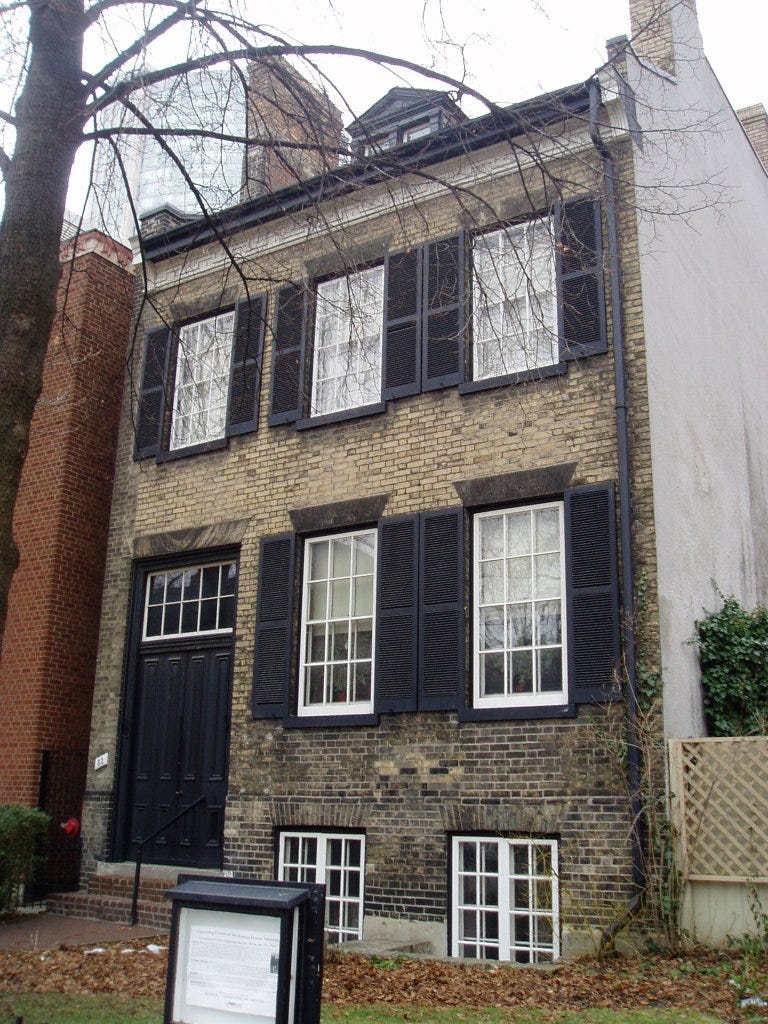
Whenever I pass by the Mackenzie House on Bond St (still shuttered) I am reminded that journalism and writing in general is going back to the direct subscription model. Mackenzie’s Colonial Advocate was his Substack, in effect - or his YouTube channel. That is what papers were before advertising. Publications partisan or personal, produced on a printing press in someone’s basement.
The question is if the slow writing of books, fiction and nonfiction, will be forced to adjust in this direction too. I am constantly surprised, as I browse through the Substack suggestions on who to follow, by the number of authors from traditional publishing who have active profiles there. The minority are enjoying themselves and thriving, others have created strict rules of purpose and time management for themselves and do just one thing, and others are there only nominally or as readers only. Authors who teach writing, and artists who teach painting and drawing, have found a great friend in Substack by incorporating it in their teaching practice. It’s excellent for client outreach and retention (ahem). But all that is not writing. Self-promoting is not writing. Platform building is not writing.
The greatest privilege for a writer is not to have to be on anything, not even Substack. See under Smith, Zadie. But I remember thinking while reading her last collection of essays, all of which have been previously published in print media, how late many of them read. Some absolutely timeless; others preserved in the year they were written in and entirely of that time (ah the debates of the distant 2021). This issue has been dealt with more thoroughly on literary Substack last year, I found myself thinking.
So yes, fine, let’s be online. But not too much. And especially not on Meta platforms. I am sorry, time spent on Instagram is not work. Even when we post about nothing but books. And it pains me to say it, but time spent on Substack Notes, the social media platform that Substack’s investing a lot in, isn’t either.
I don't think any of this is intentional, and I don't think it's actually increasing sales, except among book reviewers and culture commentators (the latter group isn't even reading the book). Most people are here to gawk at the drama. If anything, this is making Lindy West's book seem exhausting, dated, and delulu, which I'm not sure is convincing people to buy it. Especially since you can just go on Youtube and have a bookfluencer break down the book in detail for you with context, in 24 parts. That's what I did with Elizabeth Gilbert's latest. I just wanted the drama, not to actually read what she had to say.
People still want self-awareness from memoirs, even if it's a trainwreck the author is writing about. Especially if it's a trainwreck. People are quite uncomfortable reading books which involve the author still processing their issues. They want to read what the author has to say from the other side of it all. You could have committed murder, but you gotta narrate from the point of view of the readers, not of someone still justifying the murder.
I say this as someone who reads a lot of memoirs. People read books, especially memoirs, as a way to understand how to navigate this crazy world we're in. They don't want to go on a boat ride helmed by an unreliable narrator. They want someone who knows the landscape of the world they are talking about well and will actually bring them out safe with a few lessons well-learned.
This quote - “The art form will become whatever produces digital success. Esthetically necessary = what brings online engagement.” is exactly what happened to stand up. It suck’s.